
Hill’s
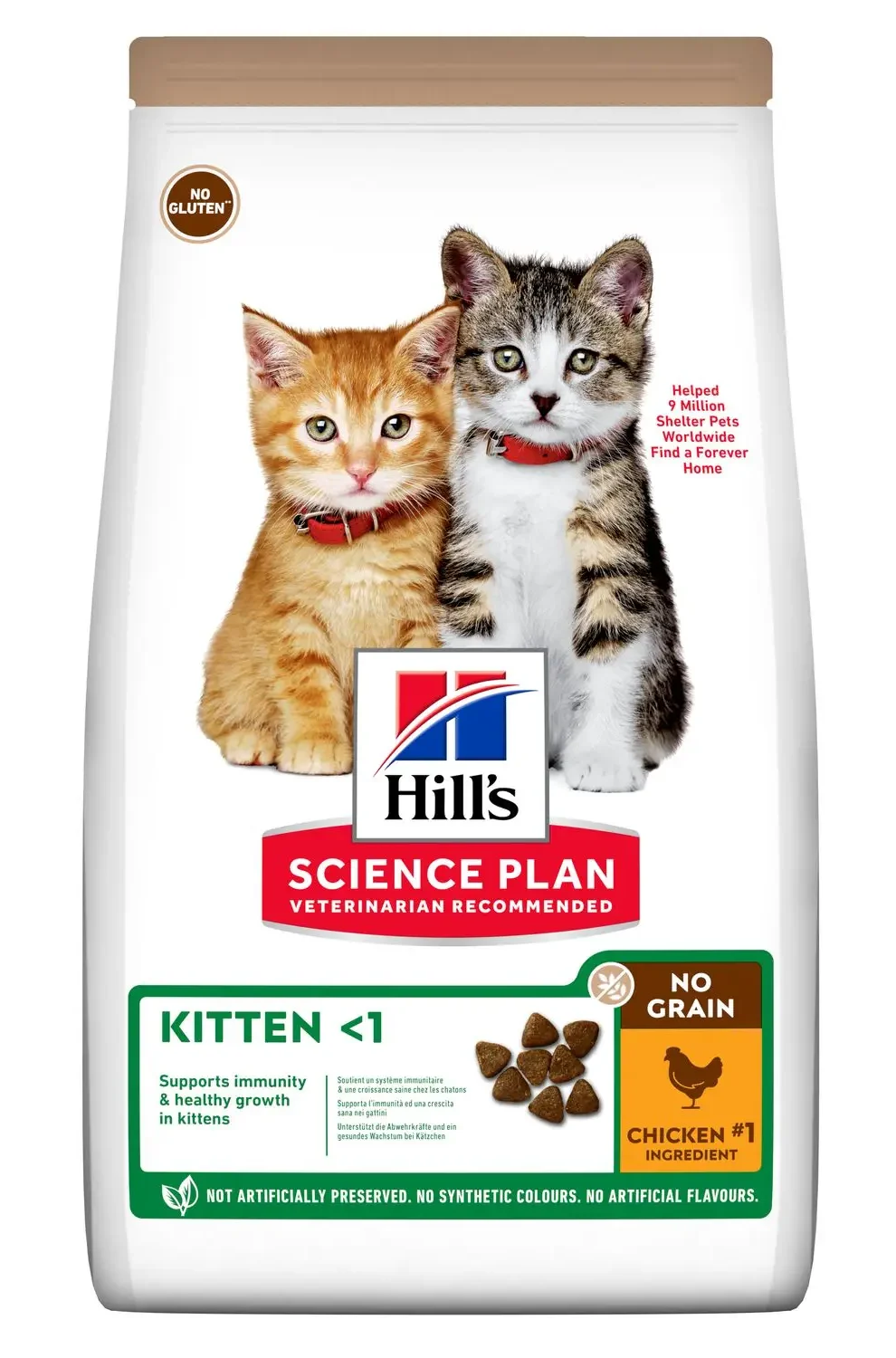
Science Plan - Kitten Chicken No Grain
Summary
Hill’s Science Plan – Kitten Chicken No Grain is a grain-free dry food formulated to support the developmental needs of growing kittens, providing essential nutrients for healthy growth, immunity, and organ development.
The first ingredient, chicken meal, is a concentrated source of high-quality animal protein that supports muscle development and tissue repair during the rapid growth phase of kittenhood.
With a high crude protein content of 35.1% and 21.5% fat, the formula delivers the energy density and amino acid profile required for active, growing kittens.
DHA from fish oil is included to support brain and retinal development, which is critical during the early stages of life when cognitive and visual systems are forming.
The absence of grains and gluten makes this formula suitable for kittens with sensitivities to common cereal ingredients, utilizing alternative carbohydrate sources such as potato starch and peas.
Yellow peas, dried peas, and beet pulp provide fermentable fiber that supports digestive health and helps maintain a balanced gut microbiome.
Essential minerals such as calcium (1.32%) and phosphorus (0.94%) are present in appropriate ratios to support skeletal development and strong teeth.
Omega-3 (1.05%) and omega-6 (3.62%) fatty acids contribute to healthy skin, a shiny coat, and support anti-inflammatory processes.
Antioxidant support is provided through high levels of vitamin E (443 mg/kg) and vitamin C (97 mg/kg), which help strengthen the immune system during early life stages.
Taurine at 0.2% ensures proper cardiac function and visual health, both of which are essential for growing kittens.
Nutrition
Ingredients
- Chicken meal 40%
- Animal fat
- Potato starch
- Yellow Peas
- Dried peas
- Dried potato
- Minerals
- Vegetable Oil
- Fish Oil
- Dried Beet Pulp
- and also:
Vitamins and Additives
- Vitamin A 11706 IU
- Vitamin C 97 IU
- Vitamin D 918 IU
- Vitamin E 443 IU
Guaranteed Analysis
Guaranteed Analysis
More products from Hill’s


Alternative Products
We compare key factors such as overall score, life stage, and category, along with core nutritional values like protein, fat, fiber, and metabolizable energy.
While not identical, these products fall within a defined range to offer nutritionally comparable options.



Found a mistake?
Missing info?
Provide as many details as possible about Hill’s: Science Plan – Kitten Chicken No Grain so we can make it better!
Thank you!
How the score is calculated?
The actual calculation of the score is based on sophisticated and advanced algorithm that takes into account multiple parameters.
To simplify the explanation, the calculation is based on three main criteria:
(1) Amount of protein (more is better)
(2) Amount of carbohydrates (less is better)
(3) Quality and source of ingredients.
Based on that 3 main criteria, 9 score calculation rules are used to compare the different foods.
One major assumption is that the closer an ingredient is to the top of the ingredient list, the greater its relative weight and contribution to the food.
In general, cat food is composed of protein, fats, carbohydrates, fibers, vitamins, and minerals.
Protein is the most important component in a cat's diet, and cats primarily get their protein from animal meat.
Fat is a primary source of energy and essential fatty acids.
Carbohydrates are controversial in a cat's diet, as cats are obligate carnivores and typically consume very few carbohydrates.
Fibers play an important role in digestion and food absorption, and vitamins and minerals are essential for different organism functions.
Dry matter values are used to compare the amount of nutrients in different cat foods. This means that moisture is excluded from the equation to provide a more accurate comparison.
Putting all of these and more into a formula results in a product score.
The maximum score a cat food can receive is 100. Points are added or removed based on the score calculation rules.
Didn't find a dry food?
Provide as many details as you can so we can analyze the missing product and add it.
[quillforms id="14695" width="100%" min_height="500px" max_height="auto"]