

Kis-Kis
Adult Delicacy, Rich in Poultry, with Herring
Summary
Kis-Kis Adult Delicacy, rich in Poultry with Herring, is a super-premium-quality dry food formulated for adult indoor and outdoor cats of all breeds.
The recipe combines highly digestible proteins, including poultry and herring, to support optimal digestion and nutrient absorption.
With urinary pH control (around 6.9), this food helps minimize the risk of struvite crystal formation, promoting urinary tract health.
It is enriched with omega-3 and omega-6 fatty acids for skin and coat health and prebiotics like FOS and MOS for digestive support.
Additional benefits include hairball control, heart function support via taurine, and odor reduction through yucca schidigera extract.
Pros:
- Urinary health: Maintains a urinary pH of 6.9 with controlled magnesium and phosphorus levels to reduce the risk of struvite crystals.
- Digestive support: Contains prebiotics (MOS and FOS) to enhance gut flora and improve bowel health.
- Skin and coat health: Rich in omega-6 and omega-3 fatty acids (ideal 5:1 ratio), EPA, and DHA for a shiny coat and reduced inflammation.
- Hairball control: Includes fibers that aid gut motility, reducing hairball formation.
- Odor control: Yucca schidigera extract reduces ammonia and other odors from feces and urine.
Cons:
- Grain content: Includes cereals, which may not be suitable for grain-sensitive cats.
- Moderate protein level: At 30%, the protein content is adequate but lower than some premium alternatives.
- Limited flavor diversity: Primarily focuses on poultry and herring, which might not appeal to all cats.
- Fat content: A crude fat level of 14% may be less suitable for cats on strict weight control diets.
Nutrition
Ingredients
- Cereals
- Meat and meat products
- Derivatives of vegetable origin
- Oils and fats
- Fish (herring) and fish products (herring)
- Minerals
- and also:
Vitamins and Additives
- Vitamin A 19800 IU
- Vitamin B1 11.7 mg/kg
- Vitamin B2 10.2 mg/kg
- Vitamin B6 7.2 mg/kg
- Vitamin B12 54 mcg
- Vitamin C 72 mg/kg
- Vitamin D3 1980 IU
- Vitamin E 135 mg/kg
- Vitamin K3 1 mg/kg
- and also:
Vitamins:
Vitamin A (retinyl acetate)
Vitamin D3 (cholecalciferol)
Vitamin E (all-rac-alpha-tocopherol)
Vitamin K3 (menadione nicotinamide bisulfite)
Trace elements:
(Zn) Zinc (zinc sulphate monohydrate) 200 mg/kg
(Fe) Iron (iron-(II)-sulphate monohydrate) 120 mg/kg
(Mn) Manganese (manganese-(II)-oxide) 46 mg/kg
(Cu) Copper (cupric-(II)-sulphate pentahydrate) 6.0 mg/kg
(I) Iodine (potassium iodide) 1.20 mg/kg
(Se) Selenium (sodium selenite) 0.20 mg/kg
Sensory additives: Yucca Extract 125 mg/kg
Guaranteed Analysis
Guaranteed Analysis
More products from Kis-Kis

Adult Dolce Vita rich in Veal, with Herring

Adult Mon Amour, Rich in poultry, with lamb

Adult Original, Rich in Veal and Chicken, with Herring
Alternative Products
We compare key factors such as overall score, life stage, and category, along with core nutritional values like protein, fat, fiber, and metabolizable energy.
While not identical, these products fall within a defined range to offer nutritionally comparable options.

Tareco

Adult Kibble With Fish
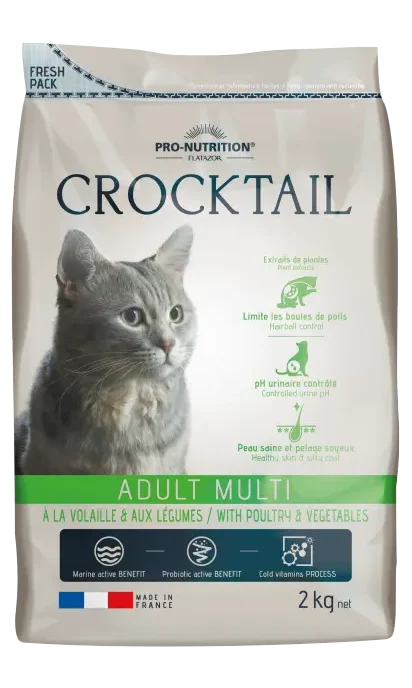
Adult Multi

Adult Kibbles with Tuna and Salmon

Complet

Found a mistake?
Missing info?
Provide as many details as possible about Kis-Kis: Adult Delicacy, Rich in Poultry, with Herring so we can make it better!
Thank you!
How the score is calculated?
The actual calculation of the score is based on sophisticated and advanced algorithm that takes into account multiple parameters.
To simplify the explanation, the calculation is based on three main criteria:
(1) Amount of protein (more is better)
(2) Amount of carbohydrates (less is better)
(3) Quality and source of ingredients.
Based on that 3 main criteria, 9 score calculation rules are used to compare the different foods.
One major assumption is that the closer an ingredient is to the top of the ingredient list, the greater its relative weight and contribution to the food.
In general, cat food is composed of protein, fats, carbohydrates, fibers, vitamins, and minerals.
Protein is the most important component in a cat's diet, and cats primarily get their protein from animal meat.
Fat is a primary source of energy and essential fatty acids.
Carbohydrates are controversial in a cat's diet, as cats are obligate carnivores and typically consume very few carbohydrates.
Fibers play an important role in digestion and food absorption, and vitamins and minerals are essential for different organism functions.
Dry matter values are used to compare the amount of nutrients in different cat foods. This means that moisture is excluded from the equation to provide a more accurate comparison.
Putting all of these and more into a formula results in a product score.
The maximum score a cat food can receive is 100. Points are added or removed based on the score calculation rules.
Didn't find a dry food?
Provide as many details as you can so we can analyze the missing product and add it.
[quillforms id="14695" width="100%" min_height="500px" max_height="auto"]